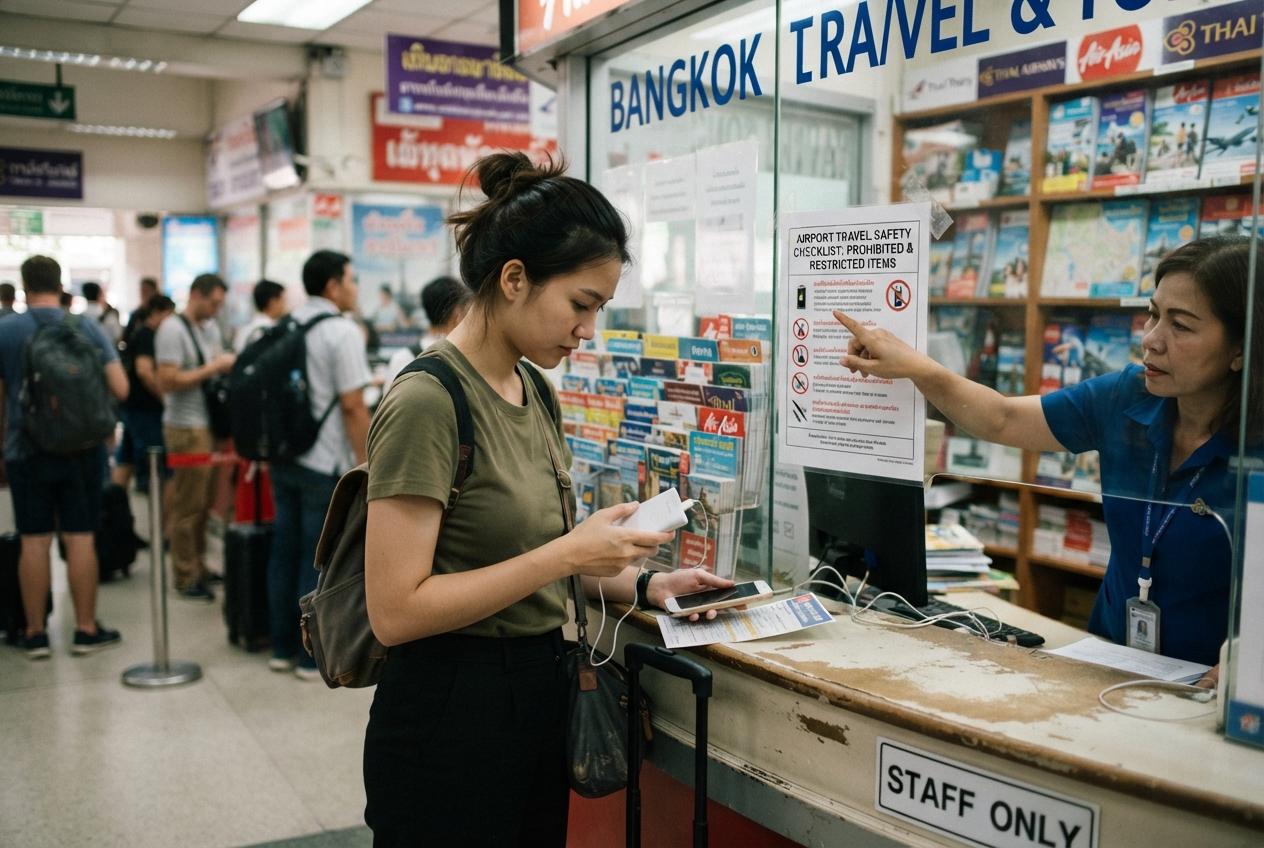
Travellers heading to or within Thailand must adhere to strict guidelines for carrying power banks, including size limits, packaging, and usage rules during flights, to ensure safety and compliance.
Thailand’s rules on power banks are straightforward enough for travellers, but they are strict. If you are flying to, from or within the country, the practical rule of thumb is simple: keep power banks in your cabin bag or on your person, carry no more than two, and do not use or charge them during the flight. Under the guidance cited by Thailand’s Civil Aviation Authority, units up to 100Wh may be carried within that two-item limit, while anything above 100Wh and up to 160Wh needs airline approval. Anything larger should not be packed in passenger baggage at all. For visitors, the key is to check the watt-hour marking before you leave home, because that is what decides whether a battery is allowed. If only mAh and voltage are shown, the watt-hour figure can be worked out by multiplying mAh by voltage and dividing by 1,000.
Travellers should also be careful not to confuse charging ports with battery count: a multi-port pack is still one power bank, while three separate units count as three. The same goes for where you pack them. Power banks are not meant for checked luggage, and if your cabin bag is taken at the gate, the batteries need to be removed first. Officials also advise protecting the terminals with the original packaging, a pouch or another barrier to reduce the risk of short circuits, and not carrying swollen, damaged or recalled units. In practical terms, that means keeping them easy to reach before screening and easy to hand over if a gate check becomes necessary.
The onboard restriction matters too. Thailand’s aviation guidance says passengers should not recharge a device from a power bank during the flight, nor charge the power bank itself from aircraft power. For consumers, that means treating it as a backup battery for use before boarding and after landing, not something to rely on in the air. Airlines may add their own operating conditions, especially for the 101Wh to 160Wh bracket, so approval should be obtained before check-in if your battery falls into that range. A 20,000mAh pack at 3.7V, for example, works out at about 74Wh and would normally sit below the 100Wh ceiling, but it still counts towards the two-unit limit.
For anyone packing for Thailand, the safest approach is to check the label, count the batteries, keep them in cabin baggage, and remove them before any gate check. If the rule looks close, verify it with the airline as well as the official aviation guidance, because the live boarding decision will be made by the carrier or airport staff applying the current rule.