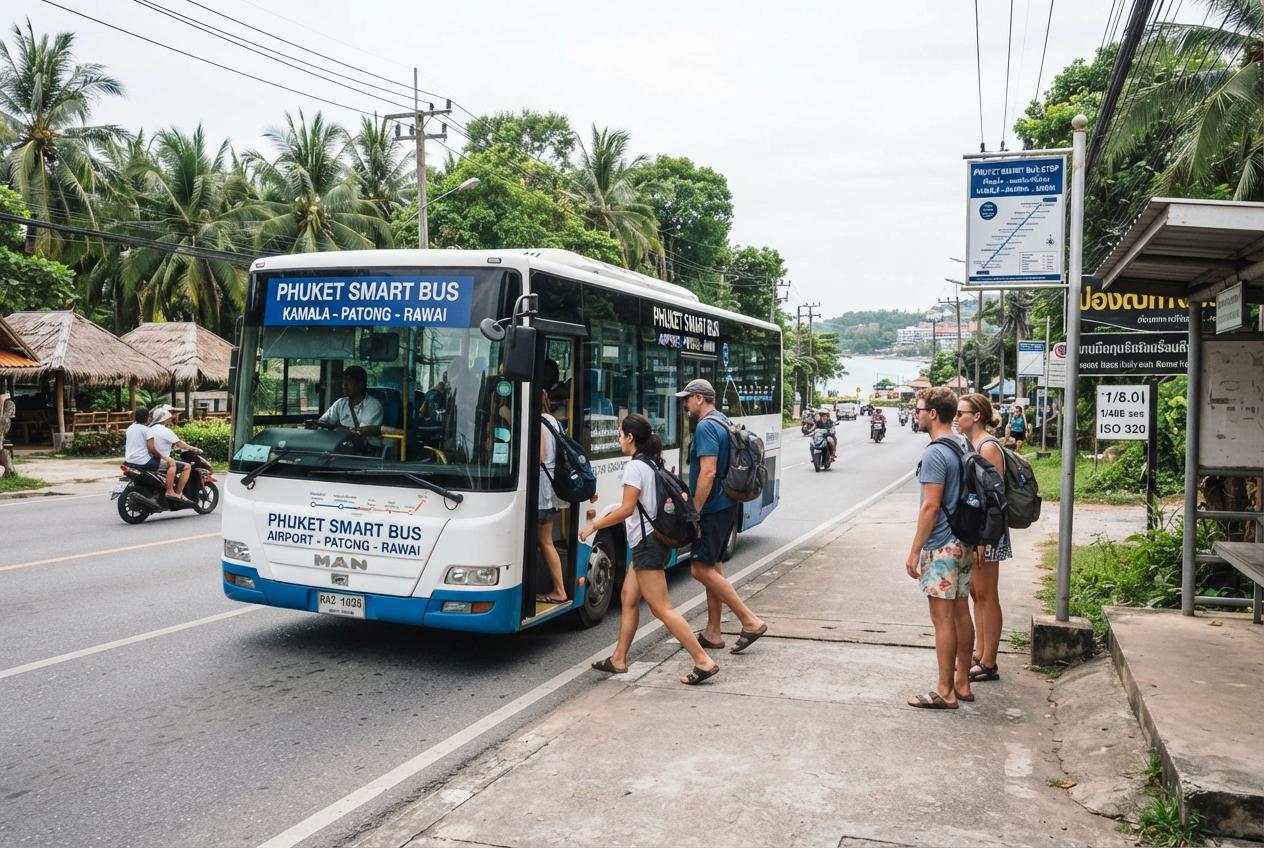
The Phuket Smart Bus provides a low-cost option for travelers heading to the island’s west-coast beaches, though its reliability depends on timing, route, and proximity to accommodation. With costs at just 100 baht and various payment options, it’s ideal for daylight arrivals and light luggage, but travellers should remain flexible and verify schedules to ensure a smooth transfer.
For travellers heading from Phuket International Airport to one of the island’s west-coast beaches, the Phuket Smart Bus can be a simple, budget-friendly option, but only if your hotel sits close to the route and you are not arriving too late in the day. The service runs down the coast towards Bang Tao, Surin, Kamala, Patong, Karon, Kata and on to Rawai, making it useful for beach stays where a short transfer from the stop is all that is needed.
The practical test is whether the bus stop and your hotel are genuinely close enough to make the journey worthwhile. Phuket’s west-coast road can be slow, and the trip to Patong is often around 90 minutes, while Karon and Kata can take closer to two hours because of the number of stops. That makes the Smart Bus better suited to daylight arrivals and lighter luggage than to late-night landings or tight onward plans.
Most guides place the airport boarding point at the departures level near Exit 3, opposite Café Amazon, although travellers should check the live stop information before setting off. The operator’s timetable can change, and Phuket’s traffic can make published times less reliable than a taxi or pre-booked transfer if you need to be somewhere at a fixed hour.
On price, the sources are broadly consistent that the Smart Bus is one of the cheapest ways to reach the west coast, with a flat fare of 100 baht per ride. Payment methods may include cash, QR code, contactless card or a Rabbit Card, so it is worth checking the current arrangement before you travel rather than assuming a single payment method will always be accepted.
For many visitors, the bus makes the most sense as part of a mixed transfer rather than a door-to-door solution. If your hotel is inland, uphill or far from the nearest stop, a short feeder taxi after the bus may still leave you ahead on cost while avoiding a long walk in heat or rain. That is especially useful for travellers with heavy bags, children or mobility concerns.
The safest approach is to treat the Smart Bus as a live service, not a fixed promise. Check the operator timetable on the day you travel, confirm the stop nearest your hotel, and keep a fallback option in case the last departure has gone or the schedule has shifted. For the right arrival and the right beach, it can be an easy, inexpensive start to a Phuket stay.