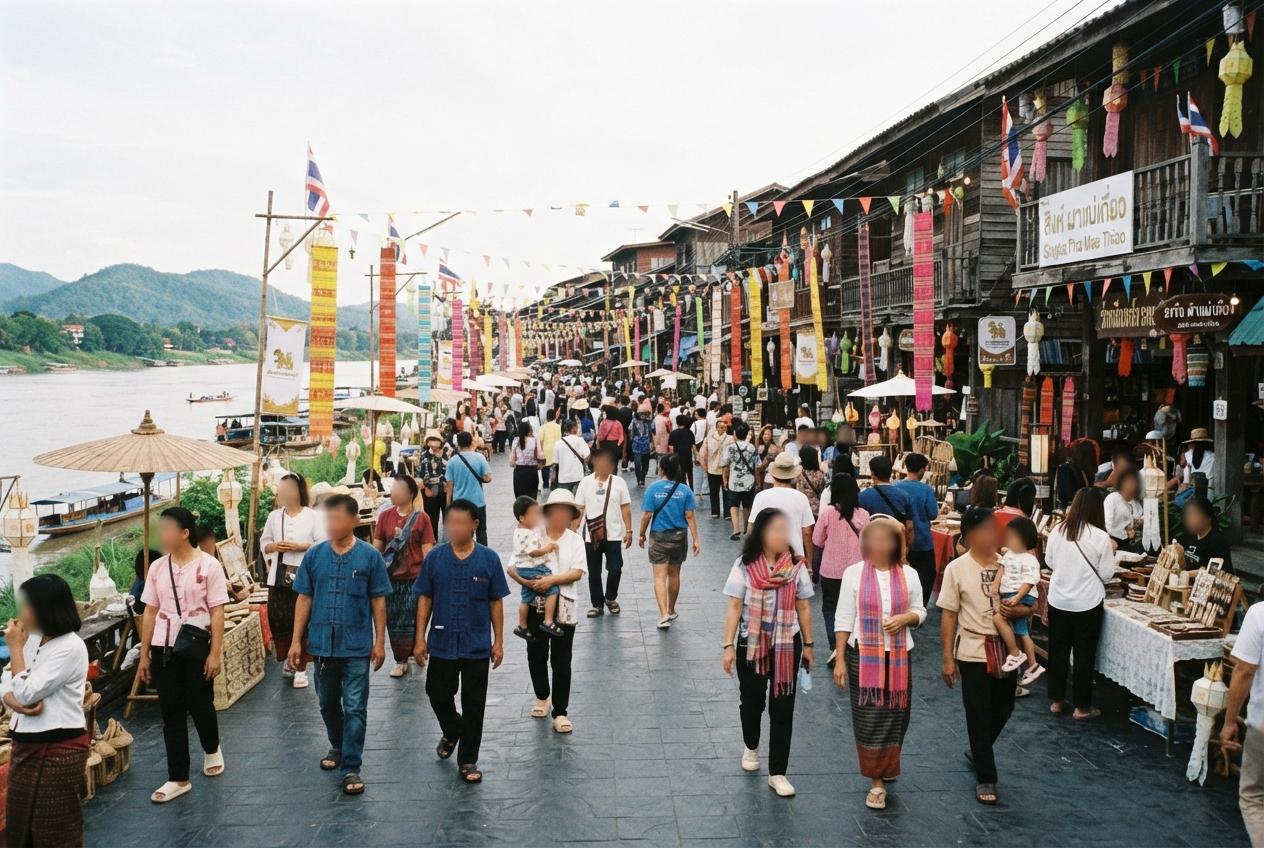
As Chiang Khan hosts its second day of the Singha Pha Mae Thiao Festival, the event brings new energy to the riverside town, emphasising sustainable and community-focused tourism that benefits local livelihoods amid Thailand’s regional tourism strategy.
Chiang Khan’s seven-day Singha Pha Mae Thiao Festival has entered its second day, but the wider significance for travellers lies in what the event could mean for one of Thailand’s most distinctive riverside towns. Set along the Mekong in Loei, the festival adds fresh energy to a destination already known for heritage buildings, local food and slow-paced river life, and it arrives at a moment when Thailand is trying to steer more visitors towards community-led places that keep spending closer to home. According to the Tourism Authority of Thailand, that shift is now central to the country’s tourism thinking, with more emphasis on quality, sustainability and regional balance.
For visitors, Chiang Khan’s appeal is straightforward: it is compact enough to explore easily, but varied enough to justify an overnight stay. The festival’s mix of food stalls, shopping and live entertainment gives travellers a ready-made reason to come now, yet the real value is that money spent in town can flow to small guesthouses, restaurants, riverside businesses and local craft sellers rather than being absorbed by a single ticketed venue. That is the kind of experience community-based tourism groups such as Local Alike say works best when culture and daily life are turned into practical visitor experiences that support local livelihoods.
The timing also matters because Chiang Khan has recently gained international recognition for sustainability. TAT said the town won the Environment and Climate category at the Green Destinations Story Awards in Berlin this year, after becoming the first ASEAN destination to receive a Silver Green Destinations Award in 2024. That gives the Mekong town a stronger platform than many secondary destinations: it is no longer just a scenic stop, but a place with proof points around environmental management and community identity. TAT has also said Thailand had 19 recognised destinations by June 2026, suggesting Chiang Khan is part of a growing national network rather than an isolated case.
The provincial picture is equally important for travellers planning a longer route. Loei recorded more than 2.5 million visitors in 2025 and tourism revenue of more than 6 billion baht, with domestic travellers making up most arrivals, according to the provincial government. That matters because it shows Chiang Khan is not starting from scratch; it sits inside an established visitor economy that already includes culture, nature, food and festival travel. For holidaymakers, that makes it easier to build a proper Loei itinerary rather than treating Chiang Khan as a fleeting photo stop.
There is also a bigger Mekong story behind the festival. Official tourism planning in Thailand and Laos has been pushing cross-border and community routes for years, including the Four Cultures of Lan Chang concept linking Loei, Xayaburi, Vientiane and Luang Prabang. More recently, the Tourism Authority of Thailand brought Lao and other Greater Mekong partners into regional cooperation discussions at TTM+, underlining the idea that towns like Chiang Khan could eventually sit inside wider itineraries rather than stand alone. For now, however, the festival remains a local event, and travellers should think of any cross-border potential as a future possibility, not an immediate product.
That said, Chiang Khan’s limits are part of its charm. As a smaller riverside town, it does not have the roomier infrastructure of Thailand’s major resort centres, so the most comfortable way to visit is to book early, stay at least one night and pair the festival with other Loei experiences such as the Skywalk, riverside walks and community food stops. Travel groups and tour operators have learned from similar community tourism projects elsewhere in Thailand, from Mae Hong Son to Krabi and southern eco-tourism communities, that the strongest results come when visitor numbers stay manageable and the local offer remains authentic rather than overbuilt. For travellers, that usually means a better trip as well.