Explore lesser-known villages, rice terraces, and historic towns in northern Thailand, revealing a richer, more authentic side of the region beyond popular destinations like Chiang Mai and Pai.
Northern Thailand may be best known for Chiang Mai, Chiang Rai and Pai, but the region’s most rewarding journeys often lie beyond the familiar circuit. For travellers with time to spare, the hills, villages and smaller provincial cities north of Bangkok offer a quieter, more varied trip: rice terraces, cultural communities, mountain viewpoints, and old trading towns that still feel lived-in rather than packaged. According to the lead article and supporting travel guides, many of these places are close enough for day trips from Chiang Mai, yet better enjoyed with an overnight stay or a slower itinerary.
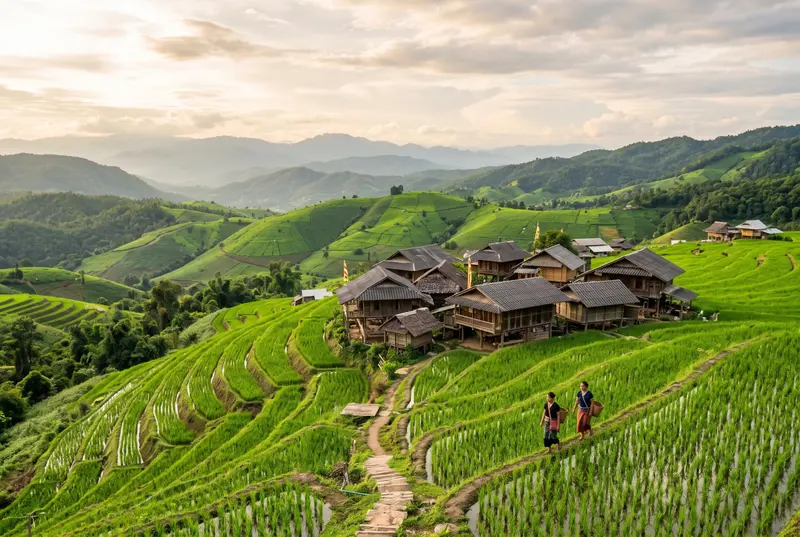
One of the strongest reasons to head into the Doi Inthanon hills is the rice landscape itself. The official Doi Inthanon National Park website says the cool dry season from November to February is the clearest and most comfortable time to visit, but the terraces around Mae Chaem have appeal for much of the year. The lead article notes that July and August bring mirror-like flooded paddies, September turns the slopes vivid green, and October and November often deliver golden harvest colours. Ban Pa Pong Piang, a Karen village deep in the hills, remains one of the most photogenic spots, and several independent guides stress that staying overnight gives visitors the best chance to enjoy the terraces at their most peaceful.
Pa Pong Piang and nearby Mae Klang Luang are the sort of places where the journey is as important as the destination. In both villages, the landscape is shaped by local farming, and visitors are not simply looking at scenery from a viewpoint: they are entering communities where rice cultivation remains central to daily life. Mae Klang Luang is also known for its informal coffee stop, where local growers welcome travellers with freshly brewed tea and Arabica coffee. For those wanting a gentler pace than Chiang Mai’s busy centre, these hills offer a rare combination of scenery, rural hospitality and practical accessibility.
Doi Inthanon also works well for travellers who want to mix nature with short, low-effort outings. The lead article points to Mae Klang Waterfall near the park entrance and to the Royal Project Sribhum Garden, which adds shaded paths, a restaurant and views of Sribhum Waterfall. The park website confirms that Doi Inthanon is not just about scenery; it also includes trekking trails, biodiversity and cultural sites. That makes it a good choice for visitors who want variety without committing to a strenuous expedition.
East of Chiang Mai, Doi Saket offers a different kind of reward: culture that feels rooted in craft rather than performance. The T’ai Lue Wisdom Learning Centre in Ban Luang Nuea village introduces visitors to a community that has preserved its weaving traditions, raised teak houses and customs through guided visits and welcoming ceremonies. Chiangmai Celadon, nearby in Doi Saket, gives travellers a chance to see how the region’s green-glazed pottery is made and, if they wish, to try painting their own piece. For weekend visitors, Cham Chaa Market adds a more local shopping stop, with food, textiles and handmade goods in a setting that is much less polished than Chiang Mai’s better-known markets.
South of Chiang Mai, Lamphun deserves far more attention than it usually gets. The city is one of the oldest in northern Thailand and was once the capital of the Haripunchai Kingdom. Wat Phra That Hariphunchai remains its most important sight, but the real attraction for many visitors is the atmosphere: a compact city with deep historical layers, easy wandering and strong local identity. The lead article also highlights two seasonal reasons to come: Yee Peng, when lanterns transform the temple grounds, and Salak Yom, when elaborate merit-making poles fill the site. Just across the river, Ban Wiang Yong adds a more contemporary surprise, with murals, preserved wooden houses and evidence of how the Yong community continues to protect its heritage.
Further north, Lampang offers something even rarer in Thailand: a provincial city that still shows its teak-boom past with clarity. The lead article recommends arriving by train from Chiang Mai, which gives travellers a more scenic, slower approach and crosses historic railway landmarks on the way. Once in Lampang, horse-drawn carriages, old teak houses and the Railroad Park provide an easy introduction to the city’s history. For anyone interested in a destination that is less polished but more distinctive than the usual northern stopovers, Lampang is one of the region’s strongest day-trip or overnight options.
The mountains beyond Chiang Mai are best known to many visitors for elephant tourism, but the lead article makes a strong case for looking wider. Around Mae Rim and Mae Taeng, there are campgrounds for cool-season nights under the stars, floating cabins and restaurants on Sri Lanna National Park’s lake, and enough water, forest and mountain air to justify a longer stay. The floating restaurants on Mae Ngad Dam Lake sound especially appealing for travellers who want a low-stress day of swimming, kayaking and eating on the water. In winter, the higher camps also offer a rare northern Thailand experience: mist in the valleys at dawn and, in the right week, a meteor shower overhead.
Pai remains the best-known name on this list, but it still has a few worthwhile corners. Pai Canyon offers dramatic views at sunrise or sunset, though it is exposed and unsuitable for anyone uneasy with heights. Yun Lai Viewpoint is better for early risers, with its sea-of-mist panorama over the valley below. At the foot of the hill, Santichon Chinese Village has become more touristy, but it still reflects the area’s unusual history and works well as a short stop after sunrise. For travellers pushing farther north, the Mae Hong Son Loop opens up a more rugged landscape still: Mae Hong Son city itself, the ridge-top noodles at Ban Ja Bo, and Ban Rak Thai near the Myanmar border all reward those willing to trade convenience for atmosphere.